CASA_AR: when Casablanca’s memory comes alive in your hands
An unprecedented augmented heritage project, developed in collaboration with CasaMémoire, turning Casablanca’s seafront into a living open-air museum.
Imagine pointing your smartphone at El Hank Lighthouse and watching the history of this century-old beacon unfold in three dimensions — its construction in 1916, the light that guided ships from 55 kilometers offshore, the stories of those who lived inside it. That is exactly what CASA_AR offers: transforming a walk along Casablanca’s corniche into an immersive heritage discovery experience, accessible to everyone, with no app to download.
A project born from a conviction: heritage belongs to everyone
Casablanca rarely tells its own story. A forward-looking economic metropolis, it nevertheless carries within it extraordinary layers of history — Art Deco architecture, coastal sacred sites, colonial lighthouses, royal mosques — that most of its inhabitants and visitors know only on the surface.
It is in this context that CasaMémoire, the leading association for the preservation and promotion of Casablanca’s heritage, invited me to design an augmented reality experience for the 15th Casablanca Heritage Days. The goal: to use technology not as an end in itself, but as a vehicle for emotion, access, and transmission.
This project marks a first for CasaMémoire in the use of augmented reality. And for me, a Franco-Moroccan digital artist working at the intersection of interactive creation and cultural identities, it is a deeply personal mission.
« Digital technology should not replace the experience of place — it should reveal what the naked eye can no longer see. » — Kamel Ghabte, CASA_AR designer
Three artworks, three sites, one continuous story
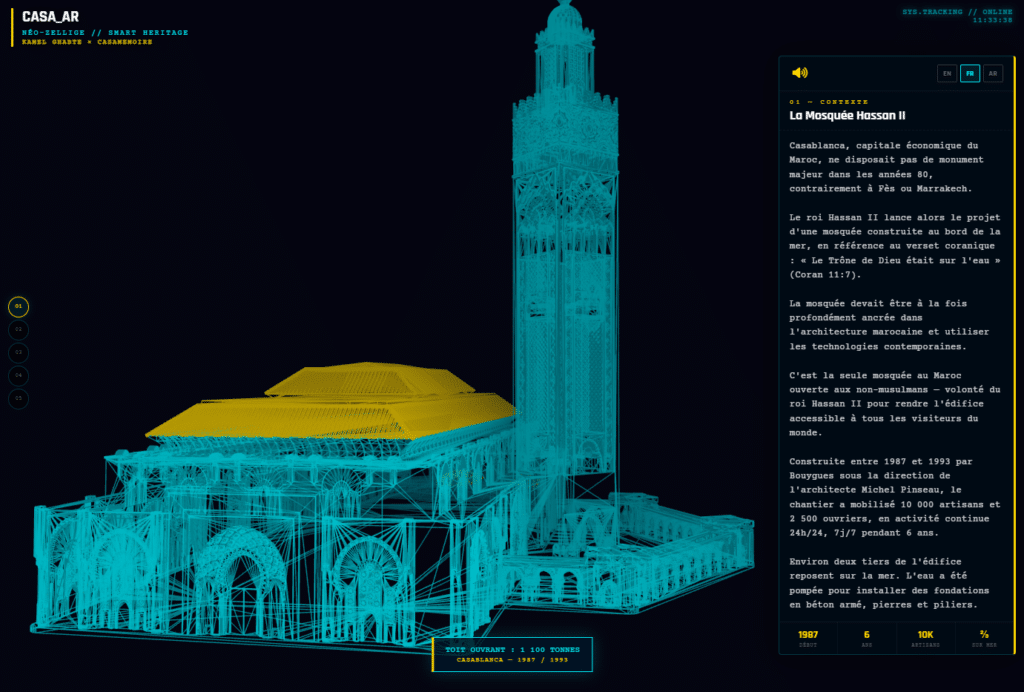
CASA_AR unfolds along a coastal circuit along Casablanca’s corniche. Each stop is a standalone artwork: an interactive 3D model of the site, trilingual historical content (French, Arabic, English), and an audio narration. All of it accessible directly from your smartphone browser.

Built between 1987 and 1993 on the Atlantic Ocean, designed by Michel Pinseau, mobilizing 10,000 craftsmen over 6 years. The AR experience breaks the monument into architectural layers: minaret (210 m), prayer hall, sliding roof, marine foundations. A meditation on the meeting between traditional Moroccan art and contemporary engineering.
Architecture · Royal HeritageErected in 1916, designed by Albert Laprade with a crown directly inspired by Moroccan minarets, operational since August 1, 1920. 51 meters tall, a range of 55 km. Before the Hassan II Mosque, it was the tallest building in Casablanca. The AR experience restores its role as a sentinel of the Atlantic.
Colonial Architecture · MaritimeA rocky islet a few meters from the corniche, home since the 19th century to the mausoleum of a marabout from Baghdad nicknamed « Moul Majmar » — the man with the brazier. A site of women’s pilgrimage (ziyara), baraka and divination. The AR artwork restores the sacred and intangible dimension of a place few approach without understanding.
Sacred Heritage · Living Memory

Technology in service of emotion
CASA_AR is built entirely on open web technologies — no app to download, no specialized hardware. A smartphone, a browser, and you step into Casablanca’s augmented heritage.
A technical pipeline built for longevity
The 3D models of the sites were processed through a professional pipeline: conversion of STL files to GLB with Draco compression (up to 90% reduction in file size), then integration into Three.js scenes with orbital controls, dynamic lighting and information overlays. The navigation circuit between sites uses an interactive Leaflet.js map deployed on Netlify.
Each artwork features an activatable trilingual voice narration (French, Arabic, English), making the experience accessible to local populations, the Moroccan diaspora, and international visitors.
- Three.js r128
- Draco Compression
- Leaflet.js
- Web Speech API
- GLB / glTF Pipeline
- HTML5 / Vanilla JS
- Netlify CDN
- Responsive Mobile-First
Who is it for? Discovery, rediscovery, belonging
CASA_AR is designed for very different audiences, all sharing the same promise: reconnecting with a city’s history through a sensory, interactive experience.
Residents: rediscovering what you think you know
For Casablancans, the corniche is an everyday place — a walk, a familiar horizon. CASA_AR proposes a reversal: the place you cross every day holds stories no one has ever told you. Why does this lighthouse look like a minaret? Who was Sidi Abderrahmane really? Which king decided to build a mosque on the ocean, and why?
The experience offers residents an unprecedented feeling: inhabiting a city you are (re)discovering. It is an invitation to look differently at what you thought you knew by heart.
Tourists: an in-depth cultural immersion
Casablanca is often a transit stop — a city people pass through without truly stopping. CASA_AR gives it back a narrative depth that traditional guides struggle to convey. A tourist walking the coastal circuit with their smartphone can, in two hours, access centuries of architectural, spiritual and urban history in three languages — without a guide, at their own pace.
Families and youth: learning through exploration
The interactive dimension of the 3D models — rotate, zoom, explore every detail of each monument — turns the visit into an exploration game. For children and teenagers who have grown up with smartphones, CASA_AR speaks their language while transmitting something essential: pride in their heritage.
Researchers, educators and institutions
For heritage professionals, educators and cultural tourism operators, CASA_AR is a demonstration of what field digital mediation can be: accessible, multilingual, friction-free, and built to last.
Where: Casablanca Coastal Circuit (Hassan II Mosque → El Hank Lighthouse → Sidi Abderrahmane)
When: April 13–19, 2026, 8:00 AM → 9:00 PM — free entry, no registration required
How: From your smartphone browser, no application to install
Organized by: CasaMémoire — Casablanca Heritage Days, 15th edition
CASA_AR: a living project, designed to grow over time
What is presented during the 2026 Heritage Days is only a first chapter. CASA_AR was designed from the outset as an evolving infrastructure — a digital heritage platform intended to grow continuously.
The long-term vision is that of an augmented urban museum of Casablanca: a digital space superimposed on the real city, accessible at any time, accumulating and transmitting the collective memory of the metropolis.
- Photographic and film archives — integration of period photographs, cinematographic archives, architectural plans superimposed directly onto sites
- Audio narratives and oral stories — recording and broadcasting of residents’ testimonies, neighborhood memories, folk tales connected to each place
- Illustrations and historical reconstructions — visual restitution of sites at different periods, created by Moroccan artists and illustrators
- Circuit expansion — integration of new Casablanca heritage sites: Medina, Art Deco district, Roches Noires, Ain Chock…
- Community contributions — enabling residents to contribute their own memories, photographs and stories to the shared digital heritage
- Enhanced accessibility — adaptation for visually and cognitively impaired audiences (enriched audio description)
- Native AR interfaces — evolution toward lightweight AR glasses as the technology becomes mainstream
Heritage is not a frozen archive — it is a living organism that breathes through those who tell its stories. CASA_AR aims to be the digital ground for that breath. — CASA_AR project vision
Why augmented reality is the right tool for heritage
Augmented reality has a unique quality compared to other media: it contextualizes in space. Looking at an archival photograph in a museum informs you. Seeing that same archive emerge at the exact spot where it was taken, superimposed on today’s reality, transports you.
It is this temporal superposition — the past slipping into the present, in the same place — that makes augmented reality particularly powerful for heritage mediation. It creates a presence of history that neither text, nor video, nor even the physical museum can reproduce in the same way.
For a city like Casablanca, experiencing rapid urbanization and where some heritage sites are fragile or threatened, augmented reality also offers a preservation function: digitizing these places means safeguarding them in an accessible, transmissible and enduring form, regardless of the physical fate of the buildings.
The « zero friction » model: genuine democratization
CASA_AR’s choice to work without an app to download is not incidental. In a context where smartphones are ubiquitous but app download habits remain selective, direct web access ensures no one is excluded by a technical barrier. A link, a QR code, and the experience begins.
A collaboration with CasaMémoire: where memory meets code
This project would have no meaning without the grounding that CasaMémoire represents. Founded by architects and defenders of Casablanca’s built environment, the association is the custodian of a deep and rigorous knowledge of the city’s built history. It is this knowledge that fed and guided every content decision in CASA_AR.
My role was to translate that knowledge into a sensitive, interactive experience — to find the technological form that honors the depth of the subject without betraying it through empty spectacle. It is a demanding balance, and I am honored by the trust CasaMémoire placed in me to find it.
This collaboration sketches a model I hope to see replicated: that of the artist-developer as a bridge-builder — the intermediary between those who hold historical memory and today’s audiences. A role requiring as much rigor as creative sensitivity.
A first. And a beginning.
Today, April 13, 2026, CASA_AR opens to the public for the first time, on the Casablanca corniche, as part of the Heritage Days. It is a first for CasaMémoire, a first for the project, and a first for the visitors who will cross this circuit and point their phone at El Hank Lighthouse.
I don’t yet know what they will see there — not just technically, but emotionally. Will a Casablancan grandmother recognize in the Sidi Abderrahmane AR artwork the place of her own mother’s ziyara? Will a Spanish tourist leave Casablanca with a new understanding of what a mosque built on the ocean means? Will a teenager from Hay Hassani become, through this circuit, curious about the history of their city?
These questions are my compass. And CASA_AR is only the first step of a project designed to last, to grow, and to ensure that Casablanca’s memory — all of it, in all its languages and all its layers — is one day within reach of every resident and every visitor.
The city is waiting for you. So is its heritage.