
Archéologie critique de la parole à l’ère du capitalisme algorithmique
Artiste : Kamel Ghabte, Gatien Leclere
Année : 2026
Sous-titre : The Algorithmic Stock Market of Speech
(Le Marché Boursier de la Parole)
À l’intersection de l’art numérique, de la média-archéologie critique et des études sur l’économie de l’attention, THE WORD_BROKER propose une expérience radicale : transformer la parole humaine en actif spéculatif. NOM DE CODE _ THE WORD_BROKER
Introduction
Dans les infrastructures contemporaines de la donnée, nos interactions verbales ne relèvent plus seulement de la communication : elles constituent une ressource exploitable, mesurable, monétisable.
THE WORD_BROKER matérialise cette mutation en mettant en scène une fiction opératoire : parler n’est plus exprimer, parler devient coter.
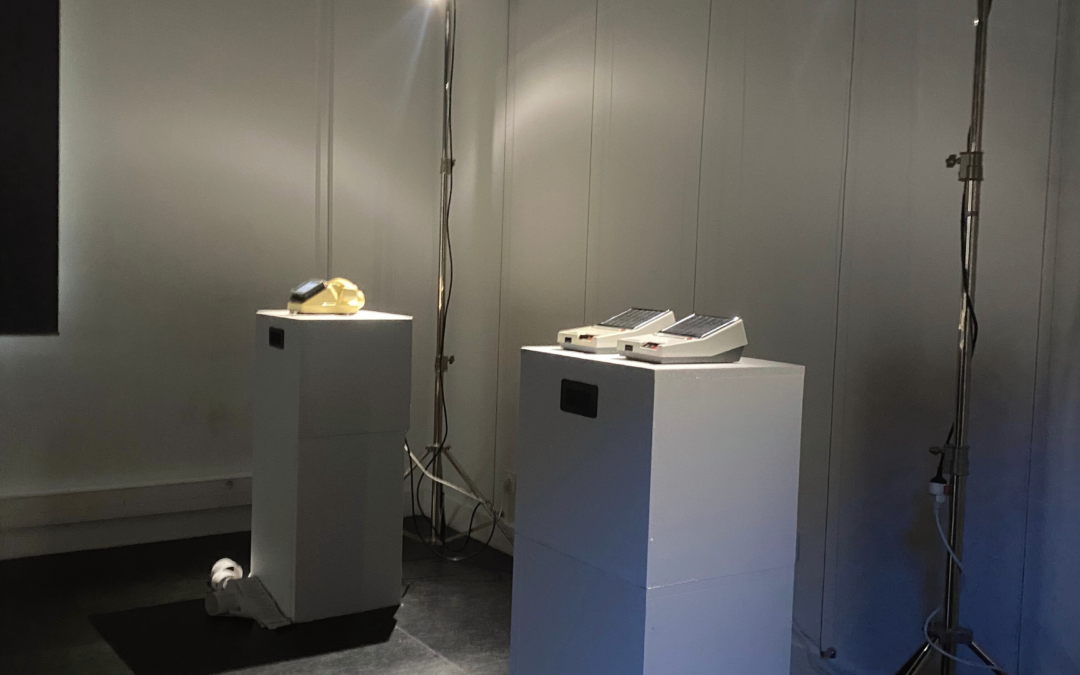
L’installation détourne deux interphones vintage des années 1970 — archétypes d’une intimité domestique — pour les reconfigurer en terminaux de trading linguistique. La machine n’évalue pas la profondeur sémantique d’une phrase ; elle isole des marqueurs lexicaux et leur attribue une valeur marchande inspirée des logiques de ciblage publicitaire.
1) Concept : de la voix au portefeuille de données
Le geste central de l’œuvre repose sur une hypothèse politique forte :
dans l’économie de l’attention, le silence est une perte de valeur.
La parole est traitée comme un flux de micro-actifs. À partir d’une phrase spontanée (désir, fatigue, projection, peur), le système extrait des mots-clés et les convertit en unités économiques. Ce déplacement est essentiel : l’énonciation intime est recodée en signal exploitable.
THE WORD_BROKER agit ainsi comme une allégorie tangible des dynamiques de la surveillance commerciale : ce que l’on dit, ce que l’on cherche, ce que l’on ressent devient un inventaire de “potentiel publicitaire”.
2) Direction artistique : Dirty Tech et matérialité critique
L’installation revendique une esthétique Dirty Tech / Critical Hacking :
boîtiers ouverts, câblage apparent, lumière rouge pulsée, mécanique visible, sonorités brutes.
- Dispositif : deux interphones beiges “hackés”, reliés à une imprimante thermique centrale ;
- Ambiance lumineuse : LED rouges évoquant charge processeur, surchauffe, alerte ;
- Ambiance sonore : absence de musique, présence d’un environnement acoustique industriel (souffle data-mining, impression agressive).
Cette scénographie n’illustre pas la technologie comme magie invisible ; elle la montre comme infrastructure extractive.
3) Protocole visiteur : une transaction froide
L’expérience est structurée en trois phases :
Phase 1 — Input (matière première)
Le visiteur appuie sur le bouton, prononce une phrase : confession, besoin, impulsion.
Phase 2 — Processing (spéculation)
L’algorithme détecte les termes monétisables, les rattache à des catégories de marché (voyage, santé, cosmétique, etc.) et calcule un prix.
Phase 3 — Output (facture)
Une imprimante thermique génère un ticket détaillé : mots détectés, tendances, bruit non monétisable, total final.
L’acte est volontairement anti-romantique : le sujet ne reçoit pas une interprétation psychologique, mais un relevé de valorisation.
4) Le ticket : artefact de preuve et critique du quotidien
Le ticket imprimé est la pièce maîtresse de l’œuvre. Il emprunte les codes de la facture commerciale pour produire un effet critique immédiat :
- horodatage (traçabilité),
- identifiant client (normalisation),
- actifs détectés (quantification du langage),
- total speech value (monétisation de l’intime),
- mention finale : “No refunds on privacy”.
L’œuvre transforme un geste banal (parler) en document comptable.
Ce basculement symbolique rend perceptible ce qui demeure souvent abstrait : la conversion de l’expérience humaine en valeur calculable.
5) Architecture technique : minimalisme robuste, intelligence locale
THE WORD_BROKER repose sur une architecture headless (sans écran) pensée pour la mobilité, la fiabilité et l’autonomie :
- Raspberry Pi 4 comme unité centrale ;
- microphone USB intégré dans l’interphone d’entrée ;
- imprimante thermique 58 mm pour la sortie matérielle ;
- amplification audio via module compact (type PAM8403).
Stack logicielle
- Vosk (offline STT) : transcription locale sans dépendance cloud ;
- NLTK : nettoyage linguistique, suppression du bruit syntaxique ;
- Broker Engine (JSON) : moteur de valorisation mots/thèmes/prix ;
- Python-ESC/POS : mise en page et impression transactionnelle.
Ce choix technique n’est pas anecdotique : il affirme une approche de sobriété computationnelle, portable, réplicable en contexte d’exposition.
6) Portée théorique : économie de l’attention, datafication, post-intimité
Sur le plan théorique, THE WORD_BROKER opère sur trois niveaux :
- Critique de la datafication : réduction du langage à des signaux marchands ;
- Critique des interfaces : transformation d’un objet domestique en terminal extractif ;
- Critique de la valeur : déplacement de la rareté de l’œuvre vers la traçabilité de l’énonciation.
L’installation fait émerger une question centrale :
si toute parole est indexable, que reste-t-il de l’intime comme espace non capturable ?
7) Pourquoi cette œuvre est stratégique en exposition
- Impact immédiat : chaque visiteur repart avec un artefact personnalisé ;
- Forte partageabilité : comparaison sociale des “valeurs de parole” ;
- Lisibilité politique : la question de la vie privée devient concrète ;
- Logistique efficace : dispositif compact, transportable, mise en route rapide ;
- Signature visuelle forte : contraste entre design rétro et critique algorithmique.
THE WORD_BROKER conjugue ainsi accessibilité publique et profondeur conceptuelle — une combinaison rare dans les pratiques d’art technologique contemporain.
Conclusion
THE WORD_BROKER n’est pas une simple installation interactive ; c’est une machine critique.
En convertissant la parole en portefeuille spéculatif imprimé, l’œuvre expose la logique fondamentale du capitalisme de plateforme : l’extraction de valeur à partir des traces les plus ordinaires de l’existence.
Entre fiction boursière et réalité infrastructurelle, elle propose une expérience à la fois sensible, analytique et politique — où chacun peut mesurer, littéralement, le prix de ses mots.
THE WORD_BROKER, Kamel Ghabte, Gatien Leclere, installation interactive, art numérique, intelligence artificielle, économie de l’attention, datafication, média-archéologie, critical hacking, imprimante thermique, art contemporain technologique
THE WORD_BROKER
A Critical Archaeology of Speech in the Age of Algorithmic Capitalism
Artist: Kamel Ghabte, Gatien Leclere
Year: 2026
Subtitle: The Algorithmic Stock Market of Speech
At the intersection of digital art, critical media archaeology, and attention-economy studies, THE WORD_BROKER proposes a radical experiment: turning human speech into a speculative asset.
Introduction
Within contemporary data infrastructures, verbal interaction is no longer just communication—it is an exploitable, measurable, and monetizable resource.
THE WORD_BROKER makes this shift tangible through an operational fiction: speaking is no longer expressing; speaking becomes pricing.
The installation repurposes two vintage 1970s intercoms—icons of domestic intimacy—into linguistic trading terminals. The system does not evaluate semantic depth; it isolates lexical markers and assigns market value according to advertising logic.
1) Concept: From Voice to Data Portfolio
The core gesture of the work is grounded in a strong political hypothesis:
in the attention economy, silence is a loss of value.
Speech is processed as a stream of micro-assets. From a spontaneous sentence (desire, fatigue, projection, fear), the system extracts keywords and converts them into economic units. The shift is crucial: intimate utterance is recoded as exploitable signal.
THE WORD_BROKER thus functions as a tangible allegory of commercial surveillance dynamics: what we say, search, and feel becomes an inventory of “advertising potential.”
2) Artistic Direction: Dirty Tech and Critical Materiality
The installation embraces a Dirty Tech / Critical Hacking aesthetic:
open housings, exposed wiring, pulsing red light, visible mechanics, and raw sonic texture.
- Device: two hacked beige intercoms linked to a central thermal printer
- Light environment: pulsing red LEDs suggesting processor load, overheating, and alert
- Sound environment: no music, only industrial acoustic cues (data-mining hum, aggressive print output)
The scenography does not frame technology as invisible magic; it reveals technology as an extractive infrastructure.
3) Visitor Protocol: A Cold Transaction
The experience unfolds in three phases:
Phase 1 — Input (Raw Material)
The visitor presses a button and speaks a sentence: confession, need, impulse.
Phase 2 — Processing (Speculation)
The algorithm detects monetizable terms, maps them to market categories (travel, health, cosmetics, etc.), and computes value.
Phase 3 — Output (Invoice)
A thermal printer generates a detailed receipt: detected words, trend indicators, non-monetizable noise, and final total.
The gesture is intentionally anti-romantic: the participant receives not a psychological reading, but a valuation report.
4) The Receipt: Proof Artifact and Critique of Everyday Life
The printed receipt is the conceptual center of the work. It borrows commercial invoice conventions to produce immediate critical effect:
- timestamp (traceability)
- client identifier (normalization)
- detected assets (language quantification)
- total speech value (intimacy monetization)
- final statement: “No refunds on privacy.”
A banal action—speaking—becomes an accounting document.
This symbolic inversion makes perceptible what often remains abstract: the conversion of human experience into calculable value.
5) Technical Architecture: Robust Minimalism, Local Intelligence
THE WORD_BROKER is built as a headless system (no screen), designed for mobility, reliability, and autonomy:
- Raspberry Pi 4 as central unit
- USB microphone embedded in the input intercom
- 58 mm thermal printer for physical output
- compact audio amplification (PAM8403-type module)
Software stack
- Vosk (offline STT): local transcription, no cloud dependency
- NLTK: linguistic cleanup and syntactic noise filtering
- Broker Engine (JSON): keyword/topic/price valuation logic
- Python-ESC/POS: transactional formatting and printing
This technical choice is conceptual: it asserts computational sobriety—portable, reproducible, and exhibition-ready.
6) Theoretical Scope: Attention Economy, Datafication, Post-Intimacy
The work operates on three levels:
- Critique of datafication: reducing language to market signals
- Critique of interfaces: turning a domestic object into an extractive terminal
- Critique of value regimes: shifting rarity from artwork to utterance traceability
It raises a central question:
if all speech is indexable, what remains of intimacy as a non-capturable space?
7) Why This Work Matters in Exhibition Contexts
- Immediate impact: every visitor leaves with a personalized artifact
- High shareability: social comparison of “speech values”
- Political legibility: privacy economics made concrete
- Efficient logistics: compact system, rapid setup, transport-friendly
- Strong visual signature: retro design meets algorithmic critique
THE WORD_BROKER combines public accessibility with conceptual depth—a rare balance in contemporary technology-based art.
Conclusion
THE WORD_BROKER is not merely an interactive installation; it is a critical machine.
By converting speech into a printed speculative portfolio, the work exposes the core logic of platform capitalism: extracting value from the most ordinary traces of human life.
Between stock-market fiction and infrastructural reality, it offers a sensory, analytical, and political experience—where anyone can literally measure the price of their words.