
Introduction
À l’heure où les systèmes génératifs redéfinissent les régimes de production culturelle, une question s’impose : que devient l’imaginaire humain lorsqu’il est absorbé, modélisé, puis réinjecté par la machine ?
THE SCRIPT_MINER répond à cette tension en proposant une installation interactive qui ne “produit” pas des récits au sens classique, mais les extrait comme on extrait une matière première : par forage, stratification et remontée de fragments narratifs.
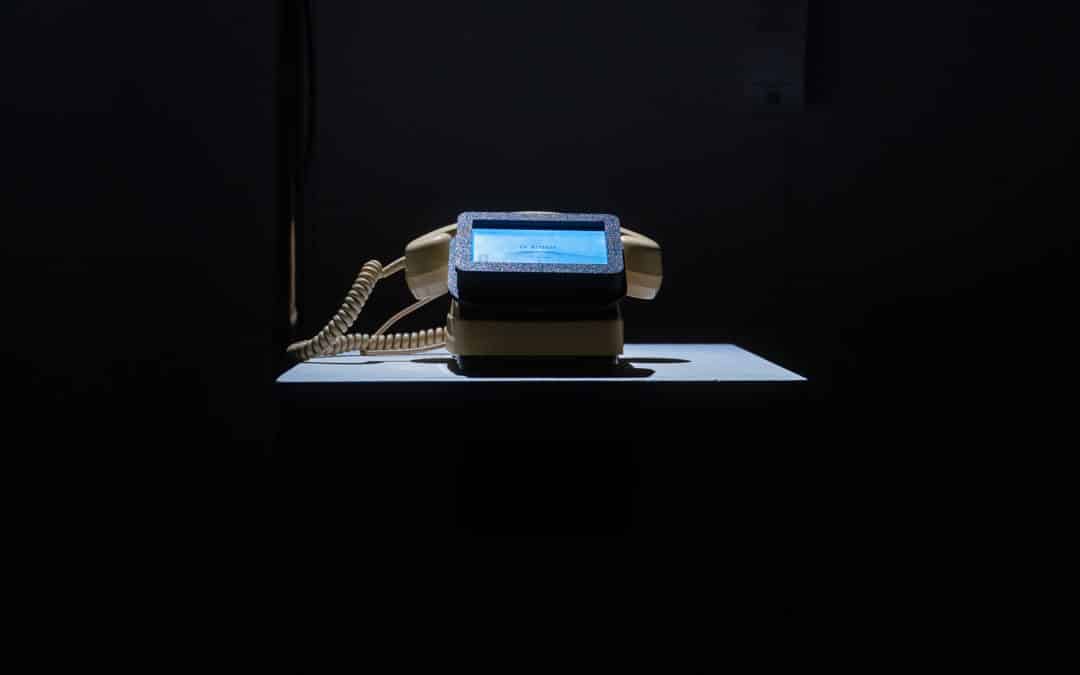
Cette œuvre se situe au croisement de l’art numérique, des sciences de l’information et de la théorie critique des technologies. Elle met en scène une machine hybride — combiné téléphonique, moteur de génération textuelle, impression thermique et diffusion numérique — pour transformer une impulsion vocale en artefact narratif unique.
Une machine qui mine plutôt qu’elle ne crée
Contrairement à l’illusion d’une intelligence artificielle “créatrice”, THE SCRIPT_MINER assume une posture archéologique :
la machine agit comme une sonde qui traverse les couches de modèles neuronaux pour faire émerger des récits potentiels déjà latents dans des espaces de probabilité.
D’un point de vue computationnel, l’œuvre matérialise trois opérations :
- Capture de l’input humain (voix, mots-clés, intention) ;
- Transformation algorithmique de cet input en script de film instantané ;
- Fixation matérielle du résultat via un ticket daté, numéroté, imprimé.
L’installation révèle ainsi une vérité fondamentale de l’IA générative : la nouveauté n’est pas ex nihilo, elle est recomposition statistique d’un champ de formes et de récits.
Protocole d’expérience : de la parole à l’artefact
L’expérience est volontairement ritualisée. Le public saisit le combiné, prononce quelques mots, puis attend la sortie d’un ticket-script.
Ce protocole condense plusieurs dimensions :
- Performative : la voix déclenche l’acte de génération ;
- Technique : l’appareil orchestre traitement linguistique, inférence et impression ;
- Symbolique : le ticket devient preuve matérielle d’un événement narratif éphémère.
Le scénario généré n’existe pas comme objet stable dans une bibliothèque infinie. Il surgit dans un instant situé, rattaché à une voix, à une date, à un numéro : un événement.
Esthétique du reçu, politique de la rareté
Présenter un récit sous forme de reçu thermique est un geste esthétique et critique.
Le reçu, habituellement associé à l’économie transactionnelle, devient ici support de fiction. Ce déplacement opère une inversion :
- la littérature se miniaturise ;
- le scénario devient trace ;
- la fiction prend la forme d’une preuve.
Dans un contexte d’hyperproduction automatisée, l’œuvre interroge la dévaluation de la singularité : si tout peut être généré en continu, qu’est-ce qui fait encore la valeur d’un récit ?
La réponse proposée par THE SCRIPT_MINER tient dans l’expérience située : la singularité ne réside plus seulement dans le texte, mais dans la rencontre entre un corps parlant et une machine calculante.
Dispositif technologique et matérialité de l’IA
L’installation articule des composants simples et une logique avancée :
- Interface téléphonique (prise de parole incarnée)
- Moteur de génération scénaristique en temps réel
- Impression thermique (trace immédiate, fragile, portable)
- QR code de restitution numérique (affiche + script à emporter)
Cette architecture affirme une conviction : la technologie n’est pas neutre.
Le design d’interaction, le choix des supports et la temporalité de sortie façonnent le sens autant que l’algorithme lui-même.
QR code, prolongement éditorial et mémoire portable
À la fin de l’expérience, le public peut scanner un QR code pour récupérer :
- une affiche personnalisée ;
- son script en version numérique à emporter.
Ce prolongement éditorial convertit l’instant performatif en archive personnelle.
L’œuvre quitte alors l’espace d’exposition pour circuler dans les usages contemporains : partage, collection, republication, mémoire distribuée.
Portée scientifique, artistique et pédagogique
THE SCRIPT_MINER s’inscrit dans un champ de recherche-création où l’œuvre devient outil de réflexion active sur :
- les régimes d’auteur à l’ère algorithmique ;
- la co-production humain–machine ;
- la matérialisation des systèmes génératifs ;
- l’économie attentionnelle des contenus automatisés.
Sur le plan pédagogique, le dispositif permet d’aborder de manière concrète des notions complexes (modélisation statistique du langage, interaction temps réel, design d’expérience, critique des interfaces) auprès d’un public large.
Conclusion
THE SCRIPT_MINER n’est pas une démonstration technophile ; c’est une proposition critique et sensible.
En transformant la parole en script imprimé, puis en archive numérique via QR code, l’installation compose une dramaturgie contemporaine de l’imaginaire :
entre extraction et invention, entre rareté et flux, entre trace fragile et mémoire calculée.
Dans cette tension, l’œuvre affirme une hypothèse forte : l’avenir de la création ne se jouera pas dans l’opposition entre humain et machine, mais dans la qualité des rituels d’interaction que nous inventerons pour habiter leurs zones de contact.
installation interactive, art numérique, IA générative, récit génératif, scénario IA, art et intelligence artificielle, expérience immersive, impression thermique, QR code artistique, recherche-création
THE SCRIPT_MINER: Algorithmic Archaeology of Imagination in the Age of Automation
Introduction
At a time when generative systems are reshaping the regimes of cultural production, one question becomes unavoidable: what happens to human imagination when it is absorbed, modeled, and then reinjected by the machine?
THE SCRIPT_MINER addresses this tension through an interactive installation that does not “produce” narratives in the traditional sense, but extracts them as one extracts raw material—through drilling, stratification, and the retrieval of narrative fragments.
This work stands at the intersection of digital art, information science, and critical technology theory. It stages a hybrid machine—telephone handset, text-generation engine, thermal printing, and digital distribution—to transform a vocal impulse into a unique narrative artifact.
A Machine That Mines Rather Than Creates
Contrary to the illusion of a “creative” artificial intelligence, THE SCRIPT_MINER adopts an archaeological posture:
the machine operates as a probe traversing layers of neural models to bring forth potential narratives already latent within probabilistic spaces.
From a computational perspective, the work materializes three operations:
- Capture of human input (voice, keywords, intention)
- Algorithmic transformation of that input into an instant film script
- Material fixation of the result through a dated, numbered, printed ticket
The installation thus reveals a fundamental truth of generative AI: novelty is not ex nihilo creation, but statistical recomposition across a field of forms and narratives.
Experience Protocol: From Speech to Artifact
The experience is deliberately ritualized. Participants pick up the handset, speak a few words, and wait for a ticket-script to emerge.
This protocol condenses multiple dimensions:
- Performative: the voice triggers the generative act
- Technical: the device orchestrates language processing, inference, and printing
- Symbolic: the ticket becomes material proof of an ephemeral narrative event
The generated script does not exist as a stable object in an infinite library. It appears in a situated moment, tied to a voice, a date, and a number: an event.
Receipt Aesthetics, Politics of Scarcity
Presenting a narrative as a thermal receipt is both an aesthetic and a critical gesture.
The receipt—usually associated with transactional economy—becomes a fictional medium. This displacement produces an inversion:
- literature is miniaturized
- the screenplay becomes a trace
- fiction takes the form of evidence
In a context of automated overproduction, the work questions the devaluation of singularity: if everything can be generated continuously, what still gives a narrative its value?
THE SCRIPT_MINER proposes a situated answer: singularity no longer resides only in the text, but in the encounter between a speaking body and a calculating machine.
Technological Apparatus and the Materiality of AI
The installation combines simple components with advanced logic:
- Telephone interface (embodied speech input)
- Real-time screenplay generation engine
- Thermal printing (immediate, fragile, portable trace)
- QR code for digital restitution (poster + take-home script)
This architecture asserts a clear position: technology is not neutral.
Interaction design, support media, and output temporality shape meaning as much as the algorithm itself.
QR Code, Editorial Extension, and Portable Memory
At the end of the experience, participants can scan a QR code to retrieve:
- a personalized poster
- their script in digital take-home format
This editorial extension converts a performative instant into a personal archive.
The work then exits the exhibition space and enters contemporary circulation practices: sharing, collecting, republishing, and distributed memory.
Scientific, Artistic, and Pedagogical Scope
THE SCRIPT_MINER belongs to a research-creation framework in which the artwork becomes an active tool for reflecting on:
- authorship regimes in the algorithmic era
- human–machine co-production
- materialization of generative systems
- attention economies of automated content
Pedagogically, the device makes complex concepts accessible to broad audiences (statistical language modeling, real-time interaction, experience design, interface critique) through direct embodied participation.
Conclusion
THE SCRIPT_MINER is not a technophilic demonstration; it is a critical and sensitive proposition.
By transforming speech into a printed script, then into a digital archive via QR code, the installation composes a contemporary dramaturgy of imagination: between extraction and invention, scarcity and flow, fragile trace and calculated memory.
Within this tension, the work advances a strong hypothesis: the future of creation will not be determined by opposition between human and machine, but by the quality of the interaction rituals we invent to inhabit their zones of contact.