A portrait that leaves a trace.
“A portrait does not only preserve an appearance. It can hold an absence, a voice, a story, a trace.”
ATHAR imagines a new form of participatory photography. It is neither a decorative selfie kiosk nor a folkloric filter: the installation is conceived as a work in its own right, at the crossroads of three gestures.
A true portrait: framing, light and print conceived as an image, not a capture.
A word, a question, a memory — or a space left deliberately empty.
Creative coding turns the traces into singular graphic compositions.
A dialogue with the museum.
The Museum of Photography and Visual Arts opened on 23 June 2026 on rue Larache, in the old medina. Its architecture, by Tadao Ando, articulates historic walls and contemporary concrete.
The city
The first exhibition, “CASA”, explores the faces and transformations of Casablanca.
The public
Participatory photography can extend the visit with an intimate, transmissible experience.
The archive
The historical collection can be echoed by a living archive, created in the present and governed by consent.
Independent proposal, unsolicited and not validated by the museum. Any installation would depend on a prior study and agreement.
One booth. Five writings.
A single booth architecture, five possible programmes — from the portrait-trace to erasure.
ATHAR
Photographing the trace
CASA 2100
Photographing the future
Les absents
Photographing absence
Portraits tissés
Photographing data
No image
Photographing erasure
From portrait to trace.
ATHAR
Gesture
Enter, be photographed, answer one essential question: “What trace would you like to leave?”
Form
Portrait, typographic fragments, lines and data; the visitor leaves with a diptych.
CASA 2100
Gesture
Be photographed, then choose a word, a future city or an idea to pass on.
Form
A “Today / Hypothesis 2100” diptych combining photography and generative art.
Les absents
Gesture
Take one seat and dedicate, if you wish, the second to an absent person.
Form
A sober diptych, negative space and a free sentence; a personal edition with no artificial reconstruction.
Portraits tissés
Gesture
Choose a portrait and watch its slow translation into graphic matter.
Form
An “image / computational weaving” diptych — an extension of the DATA RUG Protocol universe.
No image
Gesture
See yourself, choose erasure and receive a printed residual imprint.
Form
An artistic receipt of disappearance: edition number, abstract form, optional timestamp.
ATHAR as a work.
Weaving as a language.
Rather than five machines, develop a single booth architecture with a strong inaugural programme, then editorial variations. Maintenance stays manageable in self-production. Photography remains the starting point, memory guides the experience, code becomes the plastic language.
ATHAR — Casablanca
Woven portraits
CASA 2100
A ritual in five steps.
A short, guided experience — hypothesis of about 90 seconds, to be verified through public tests.
Language choice
Arabic, darija, French or English. Visual and audio instructions.
The shot
Soft light, guided framing, explicit trigger and validation of the shot.
One question
A written or possibly recorded sentence, depending on the version.
Photo + text
Photograph and text feed a deterministic or generative composition.
Personal print
The visitor leaves with their edition; a separate consent for any contribution to the public archive.
Print. Keep. Bring forth.
Each visit produces a personal edition; explicitly authorised contributions can enrich a collective work, projected or published.
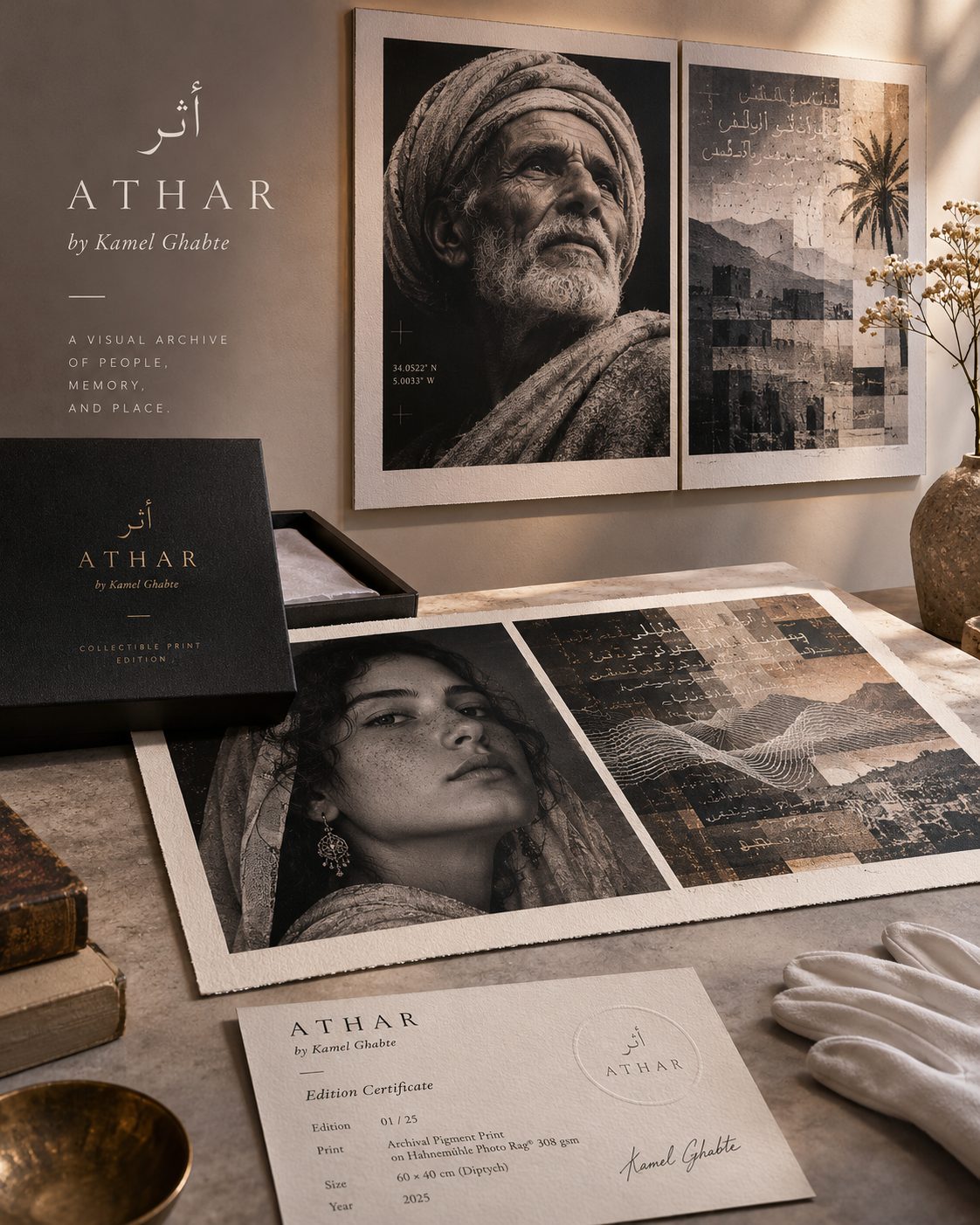
The object the visitor takes home: portrait + trace, edited and printed on site.
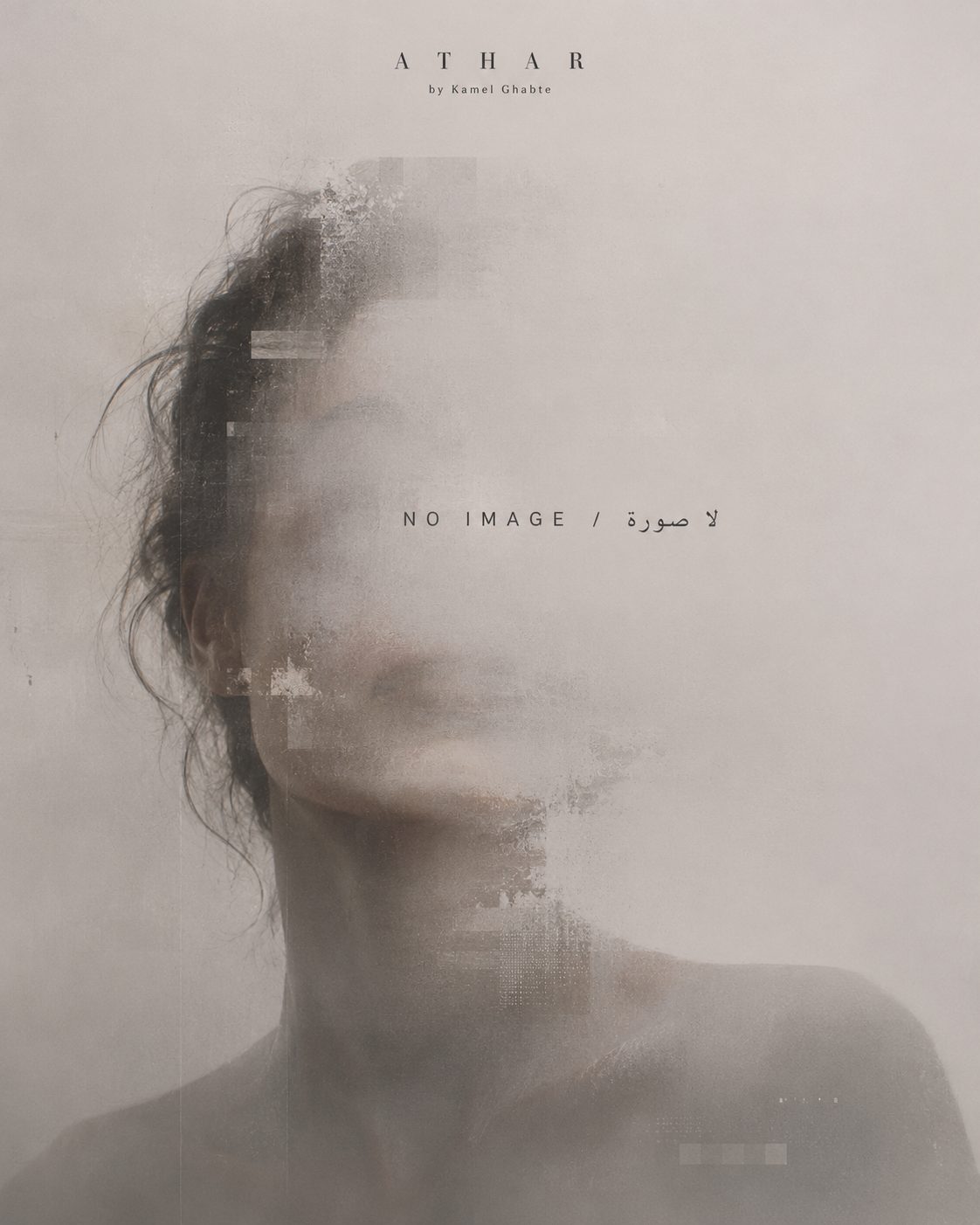
A collective, evolving composition, shown at the museum — fed only by consented contributions.
Indicative visuals generated for this proposal; no photograph of a real visitor. The final photographic visuals are being produced by the artist.
A booth, not a kiosk.
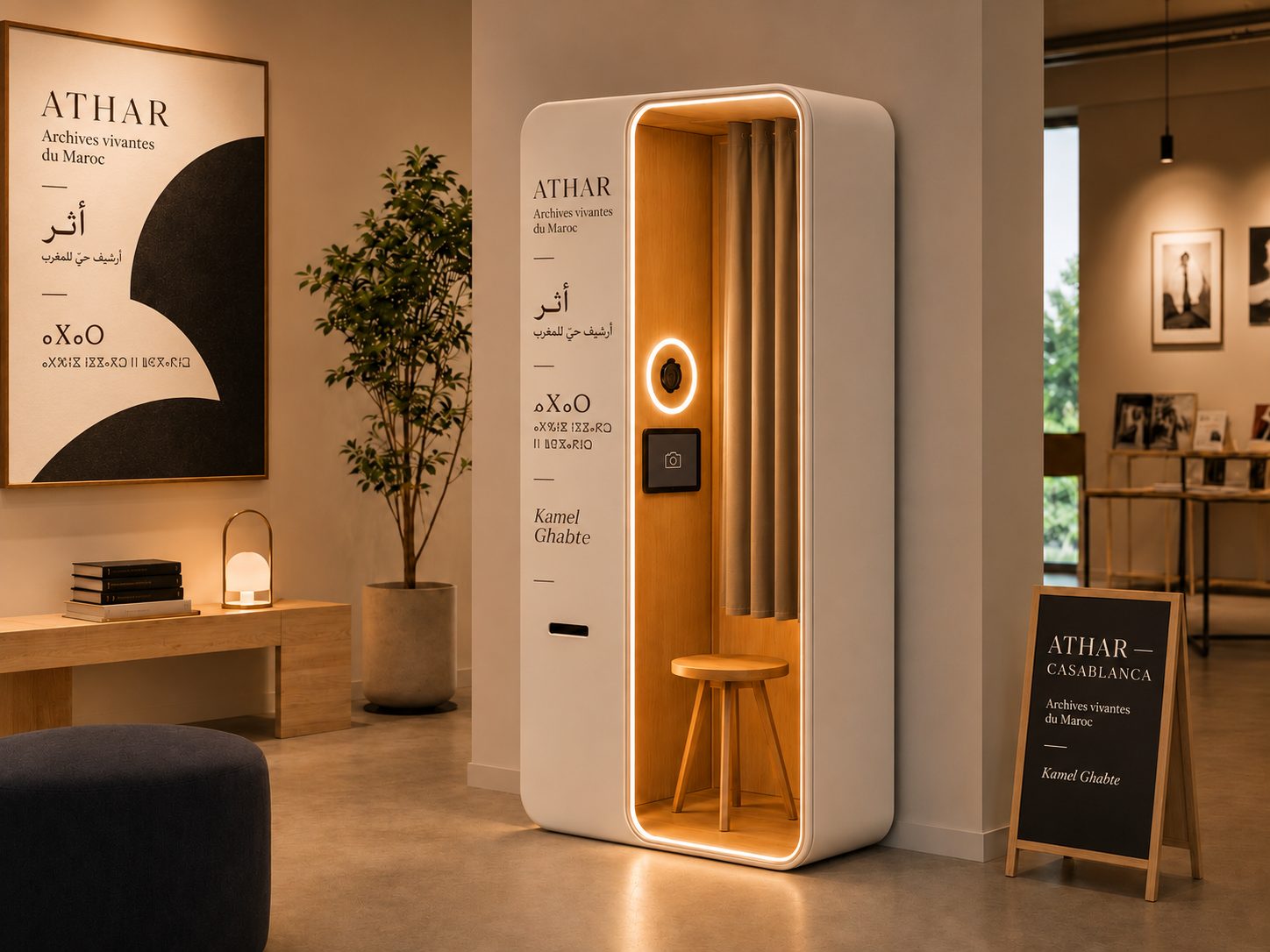
The form keeps the simplicity of the photographic reference: a monolith, a luminous opening, an intimate interior. The final aesthetic is developed specifically for the venue.
- ShellA light, matte, neutral surface.
- LightA discreet architectural outline.
- InteriorSeat, possible mirror, intimacy.
- InterfaceReadable screen, few steps.
- AcousticsTreatment to confirm per site.
Points to study on site: real footprint and flow; accessible (PRM) access or equivalent route; fire safety; power supply; fixing and installation permits; guarding and maintenance of the equipment. Reference image = formal direction, neither an ATHAR prototype nor a view of the museum.
A local system. Art modules.
A simple architecture, usable offline for day-to-day operation; no dependence on a remote service to photograph and print.
Optional module — consented archive: content intended for exhibition is kept separate from private prints and validated before any release. An admin interface tracks equipment status, the print counter, paper reloading, camera/printer tests, session erasure and guided restart.
The visitor stays in control.
Photographing a person does not mean obtaining permission to publish their image. Participation, printing, archiving and projection are clearly separated.
Granular consent
A separate checkbox for the private portrait, the archive and publication; refusal without penalty.
Minimal data
No facial recognition or identity analysis. Local processing by default.
Retention & removal
Retention period agreed with the museum; a concrete option to withdraw from the public archive.
Minors & accessibility
Adapted journey, understandable information, specific permissions for minors.
Sensitivity of stories
The question asked stays optional; no request for intimate or traumatic disclosure.
Legal framework
Moroccan law 09-08 and CNDP recommendations. Legal review prior to any deployment.
Start small. Build to last.
Framing
Technical visit, curatorial exchanges, installation constraints, data specifications.
Prototype
Design and build of a working version; light, software, print and journey tests.
Museum pilot
A proposed four-week deployment, duration negotiable, with visitor feedback and maintenance.
Sustaining
Acquisition, rental, extended residency or tour; new editions and curatorial content.
Budget structure to anticipate: artistic creation & programming · furniture fabrication · equipment purchase/rental · prints & consumables · transport & installation · mediation · insurance · maintenance · documentation / publication. No amount announced before the scope and quotes are validated.
To read.
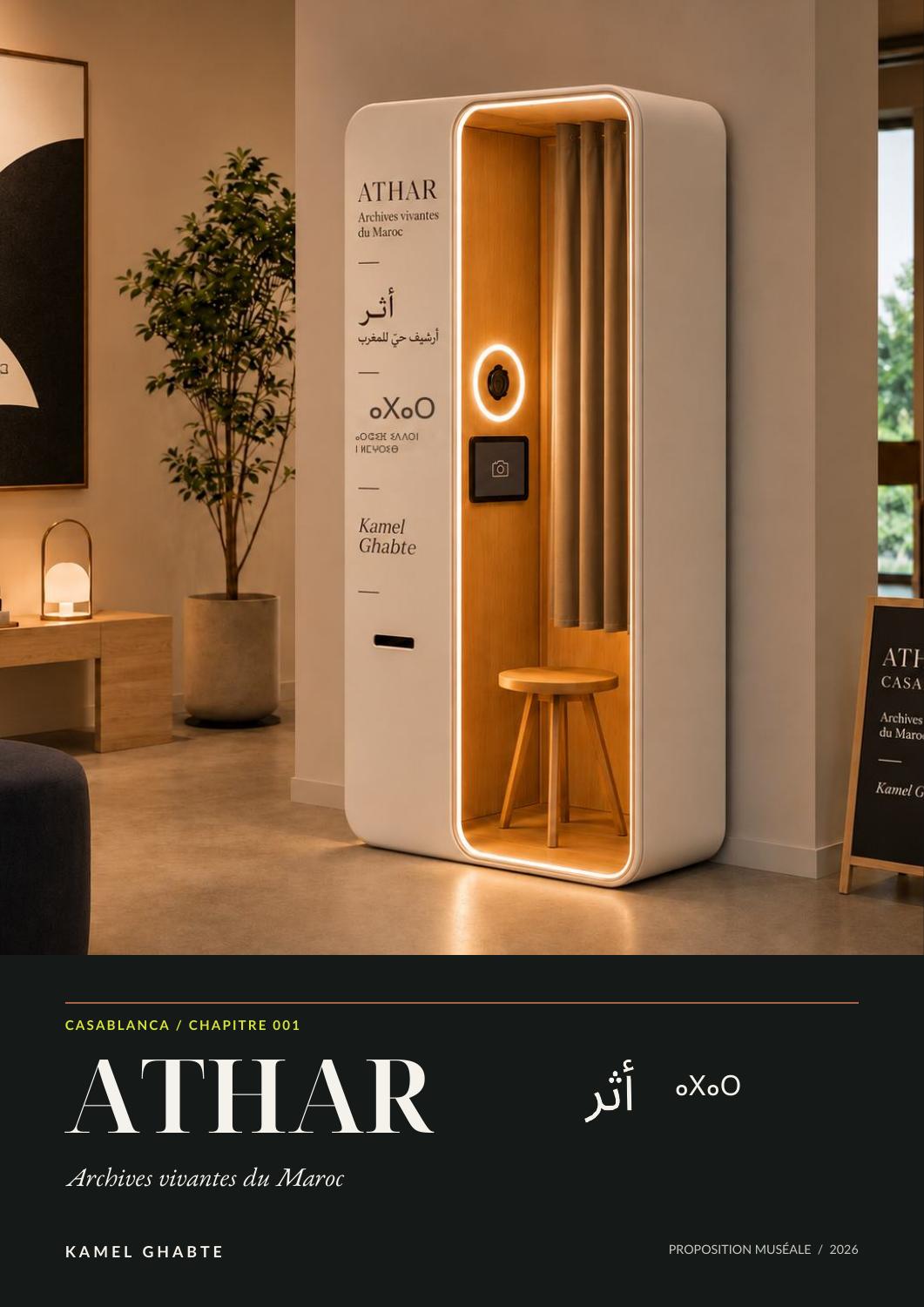
ATHAR — living archives of Morocco.
An interactive photographic installation that turns being photographed into a gesture of transmission. Between photography, generative art and living memory, ATHAR invites the public not only to look at images of the past, but to take part in creating the archives of tomorrow.
Museums & institutions: for an installation study, a pilot or an acquisition, let's talk.
Sources & credits.
Public references used to contextualise this proposal.
Visual credits: the booth photograph is a reference image provided for the study, used to illustrate a formal direction; it is not made by the artist. The other visuals are abstract graphic studies produced for this dossier — none is presented as a photograph of the museum or as an already-realised work. The final photographic visuals are being produced. This document constitutes neither institutional validation, nor a quote, nor a production commitment.